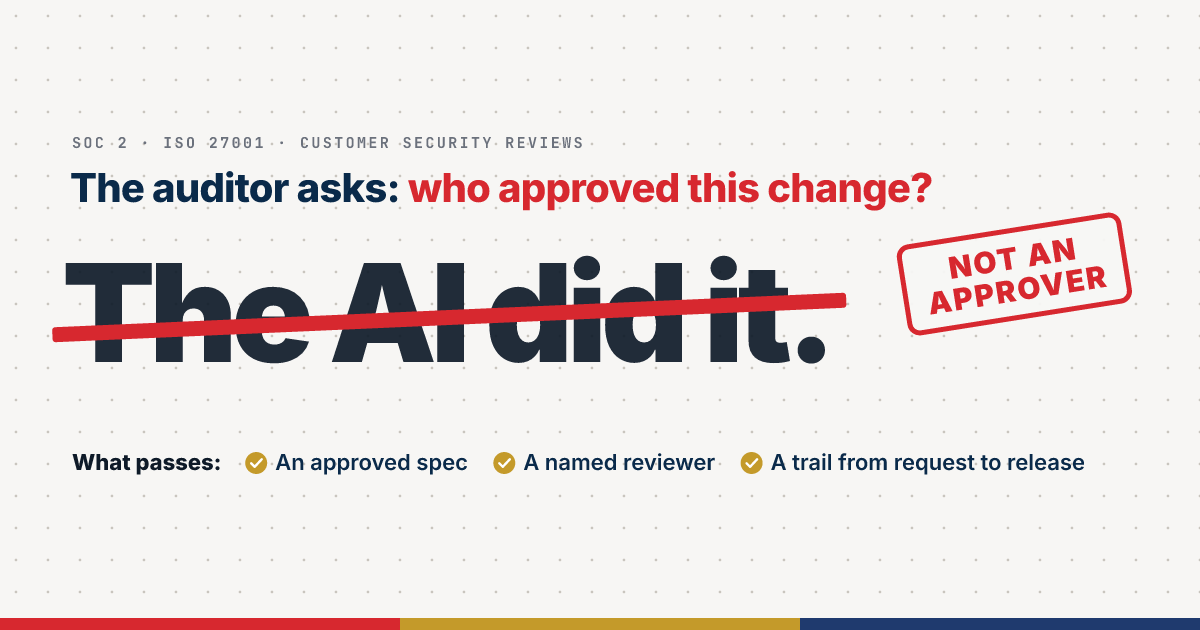
“The AI did it” won't pass your next audit
AI writes the code, agents ship the changes, model providers see the data. Auditors and customers now want to know who is accountable - and "the AI" isn't an answer.
What changed for audits in 2026, what you'll be asked, and how we help you stay compliant and get through audits faster.
What changed
AI is now inside the audit
Every audit asks the same thing a hundred ways: who did this, who checked it, who approved it? More and more often the honest answer is "the AI" - and no auditor accepts that.
- What gets audited changed. By Veracode's estimate, AI now writes roughly half of all committed code, and its 2026 tests put the average security pass rate of that code at 56%. Agents change systems; model APIs see customer data.
- How audits run changed. Auditors use AI to test whole populations of changes, not a sample. Customers ask about AI in every security questionnaire.
Large enterprises feel this first, so most of the research below comes from them. A 50-person SaaS company feels it the day its first enterprise customer sends a questionnaire.
Ten months
In 2026, the rulebook caught up
Figure 1
Most of the new AI audit rules landed in 2026. Three deadlines are still ahead.
The message is the same everywhere: there is no separate AI audit. The AICPA's September guidance (TQA 9561) adds no AI criteria to today's SOC 2, and COSO treats generative AI as an internal-control problem. AI is judged by the controls you already have. The revised SOC 2 criteria, proposed in October for audits starting from 31 December 2027, make it explicit: AI points of focus under 17 criteria, from AI agents to unapproved AI tools.
Stage by stage
What AI changes at each stage of an audit
| Stage | What AI changes | What auditors now expect |
|---|---|---|
| Scoping | AI tools, agents and model APIs sit inside the system boundary | An AI inventory, with the reason each item is in or out |
| Controls | Change, access and vendor controls were written for people | The same controls covering AI: approver isn't the author, agents have their own identity, model providers are managed as vendors |
| Evidence | More changes, while evidence is still gathered by hand | Evidence the workflow produces itself, across the whole period |
| Testing | Auditors test larger populations, not small samples | Every change holds up, not only the ones you'd show |
| Customer reviews | Questionnaires such as SIG 2026 ask about AI | Answers backed by records |
Policy is not control
A policy won't cover it
Most companies answer with an AI policy. IBM's 2026 Cost of a Data Breach report shows the gap:
Banning AI pushes it into personal accounts. Ignoring it ends in audit exceptions and stalled security reviews. What works is governing it in the flow: approvals, data boundaries and evidence that happen as the work happens.
Our role
Where QCerris fits: two ways we help
We're not your auditor, and we don't sell a compliance platform. We're the consulting and engineering partner that changes how the work flows, so the audit holds up.
Audit-ready AI
"Can we prove we control the AI we use?"
AI-powered compliance
"Why does every audit still take weeks?"
We did this on ourselves first, under ISO/IEC 27001. When your data can't leave your environment, we run self-hosted models inside your infrastructure.
The product
Where CodeMerlin fits
Most AI audit questions start in software delivery. CodeMerlin, built by QCerris, makes AI-built code audit-ready by default: one approved spec per ticket, agents working from that spec, every pull request reviewed against it, every action recorded with a name and a time.
Figure 2
Every step leaves its own evidence, so nothing is rebuilt for the audit
When the auditor asks for a sample, the trail already exists - with the same standard in every team. More on how it works in Turn AI Speed Into Enterprise Delivery.
Our process
How we work
Pick the door that matches where you are. Both lead into the same four steps.
Figure 3
Two ways in, one path to audit-ready
"The AI did it" won't pass.
"Here's the record" will.
Start with a Health Check if you already use AI, or a Quick Start if you want AI to take on compliance work.
General information, not legal or audit advice. Scope decisions belong to you and your auditor.
Sources
- AICPA - TQA Section 9561, Effect of the Service Organization's Use of AI on SOC 1 and SOC 2 Examinations (Sep 2026)
- Schneider Downs - What the new TQA means for your SOC report
- Journal of Accountancy - AICPA proposes improvements to SOC 2 trust services criteria (Oct 2026)
- A-LIGN - Proposed SOC 2 Trust Services Criteria updates
- AICPA & CIMA - New AI assurance offering from AICPA and AIUC (Oct 2026)
- Deloitte DART - COSO publication on internal controls related to generative AI
- Gibson Dunn - EU AI Act Omnibus, postponed high-risk deadlines
- AI Act Explorer - Digital Omnibus on AI
- Varonis - IBM Cost of a Data Breach Report 2026
- Veracode - 2026 GenAI Code Security Report
- Forvis Mazars - AI in SOC examinations
- Mitratech - SIG 2026 key updates