Turn AI Speed Into Enterprise Delivery
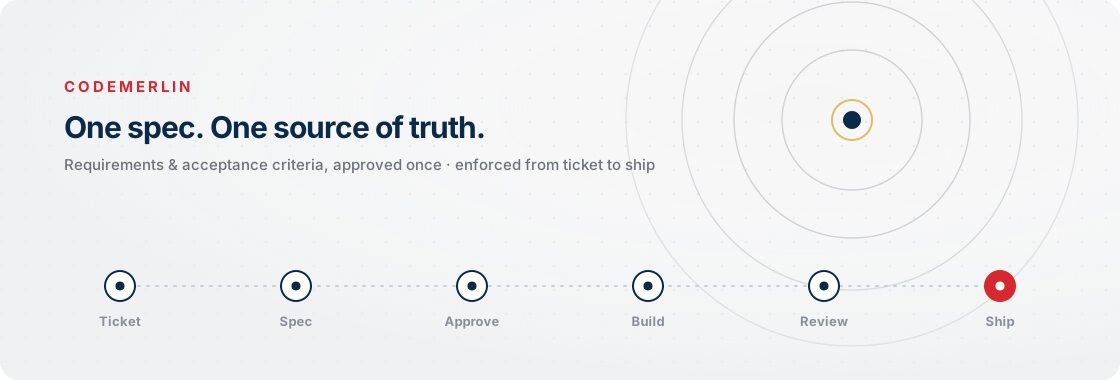
It all runs on one approved artifact - the spec: the requirements and acceptance criteria every AI agent builds from, and every pull request is checked against.
AI made writing code fast. It didn't make enterprise delivery fast - it relocated the constraint. Here's where the bottleneck went, why your tools can't fix it, and what an AI-native operating layer does instead.
The expectation gap
The throughput promise didn't show up
Every board is pressing for AI ROI, and most leadership teams have already bought the tools. The promise was a step-change in delivery velocity - 5× to 10× acceleration of every engineer, leading to similarly faster time-to-product.
The reality inside most enterprises looks different: more tokens, more experiments, more AI-generated code - and no step-change in what actually ships. Executives see activity. They do not yet see a repeatable delivery engine. AI activity went up; enterprise delivery did not. The problem was never whether AI matters - it's how to convert AI into enterprise throughput.
Where it went
Writing code was never the bottleneck
This is the uncomfortable part. Faster typing was never the real constraint on enterprise delivery. So when AI compressed the time it takes to write code, the bottleneck didn't disappear - it moved, in two directions at once.
Downstream, to code review. When one engineer can ship five times the code in a day, every reviewer becomes the chokepoint - asked to vouch for code no human fully authored, at a volume no review process was designed to absorb.
Upstream, to requirements. AI is a faithful amplifier. Feed it a vague ticket and it will confidently build the wrong thing - fast, polished, and wrong. The cost of an unclear requirement used to be caught by a developer who stopped to ask. Agents don't stop to ask.
The bottleneck moved - it didn't disappear
Why tools alone won't fix it
Licenses are not a strategy
The instinct is to fix this by buying more tools. But coding assistants - Claude Code, Cursor, Copilot, Codex - optimize the individual coding session, not the enterprise delivery system. Powerful as they are, there are four things they will never do:
Giving every engineer an AI assistant is not the same as redesigning the SDLC for AI.
Consistency at scale
Enterprise level SDLC needs AI guardrails. Even more so then individual developers and small teams
A big company doesn't have one developer - it has tens, hundreds or even thousands, each with their own habits, and the AI era made the need for consistent SDLC process even more important. Everyone reaches for different tools, prompts in their own style, and documents to their own standard. The result is too much material, too many half-aligned artifacts, uneven leadership from team to team, and acceptance criteria that shift from person to person. Quality quietly becomes a function of who happened to pick up the ticket.
At enterprise scale, that inconsistency is the real risk. Ten engineers each "doing it their way" with an AI agent doesn't add up to throughput - it adds up to drift, rework, and a codebase no single person fully understands.
This is exactly where a large organization needs one operating layer the whole company runs on: one place where intent is defined, one standard for what "done" means, one review bar, one audit trail. Not to box engineers in - but so that product, engineering, QA and leadership all work from the same definition of the work. One tool, one standard, everyone on the same page.
The missing layer
The AI-native SDLC has a missing operating layer
Your stack already has the tools. What it doesn't have is the connective tissue between them. You already run Jira, Linear, GitHub, GitLab, Cursor, Claude, Codex, Copilot, PR review and engineering analytics. What's missing is the operating layer between business intent and autonomous implementation - approved intent, context delivery to agents, intent-aware review, an audit trail, and executive metrics.
What's missing isn't a tool - it's the layer between them
The control tower
CodeMerlin is that layer
CodeMerlin is the enterprise control tower for AI software delivery. It attaches to the stack you already run - Jira, Linear, GitHub, GitLab, Cursor, Claude, Codex, Slack, Teams - and adds the AI-native SDLC layer on top: specs and tech plans, task and test plans, MCP context delivery to agents, intent-aware PR review, and an executive control tower. It doesn't replace your stack. It adds the missing operating layer above it.
Every other tool checks how code is written. CodeMerlin checks if it does what was asked.
The core of CodeMerlin
The spec is the source of truth
Not the prompt, not the chat history - the spec. It's the one approved artifact every downstream step runs on.
Start with the terminology, because it matters. In CodeMerlin, a ticket becomes one spec. That spec holds the requirements, use cases and acceptance criteria for the work - and any open questions a human needs to settle before code is written. Not many specs per ticket: one spec, with requirements inside it.
And it isn't a static document the AI hands back. CodeMerlin reads the ticket and your context, then surfaces what's ambiguous as open questions, right at the top:
- Users in SSO-enabled domains authenticate via the configured IdP; local passwords are disabled.
- Failed authentications are logged and surfaced to SecOps within the audit stream.
- Admins can enforce SSO per workspace without a redeploy.
The layout does three things on purpose. Must-answer questions block approval; lower-priority ones don't - so teams resolve what actually matters and keep moving. Each question links to the exact part of the spec it affects, so no one scrolls a massive document hunting for context. And answering can be as simple as picking an option.
Then a person approves it - accept everything, or edit any requirement - and every action is recorded: who reviewed, who changed what, and when. That audit trail is what turns "the AI wrote some code" into governed delivery you can stand behind.
One ticket, one approved spec - reviewed by a person, traceable to a name.
Once it's approved, that single spec is the source of truth everything downstream runs on: the tech plan, tasks and test plan are generated from it, the agents build against it through MCP, and every pull request is reviewed back against it.
How it works
From a vague ticket to verified delivery
CodeMerlin is a spec-driven development platform. It covers the full lifecycle - from a potentially vague ticket to a verified delivery - with a human gate at every decision that matters, and traceability from requirement to shipped code.
The golden thread, end to end
Solo vs. enterprise
Solo AI development is real. Enterprise AI development is different.
For a solo builder, coordination cost is near zero - one head holds the product intent, the architecture decisions, and the history. There are no approval chains and no legacy entanglement. That's why solo AI demos look magical.
In an enterprise, coordination is the cost. No single head holds it all. There are legacy systems and integration debt, compliance, security and audit obligations, product, QA and architecture reviews, and organizational memory spread across teams. The solo AI engineer model breaks the moment the work requires that organizational memory.
The real shape of the work
Enterprise software is a system, not just code
In an enterprise, software is not just code - code is the smallest layer. Above it sit acceptance criteria, technical and test planning, architecture and ADRs, security and compliance, and release and operational accountability. AI can accelerate every one of those layers - but only with the right context and the right control points.
The bottleneck moved from writing code to defining, coordinating, and verifying the work.
Why it unlocks velocity
AI velocity comes from removing coordination drag
The win isn't faster typing. It's removing the loops that kill enterprise throughput - the requirement gaps, the rework cycles, the architecture surprises that only surface in the postmortem.
The spec is what unlocks parallelism. The governance loop is what makes it safe.
What organizations get
A measurable operating model for AI delivery
CodeMerlin gives every level of the organization something it can act on - not just dashboards to observe, but levers to manage AI software delivery.
Far more than another code-review tool
The strategic choice
Enterprise AI velocity needs an operating layer
There are two ways to respond to the AI moment. One scales individual leverage and hopes it adds up. The other redesigns the system the work flows through.
Move faster with AI. Keep control with CodeMerlin.
See how CodeMerlin works →